
 EN
EN
How Onyx Marble Is Processed and Supplied
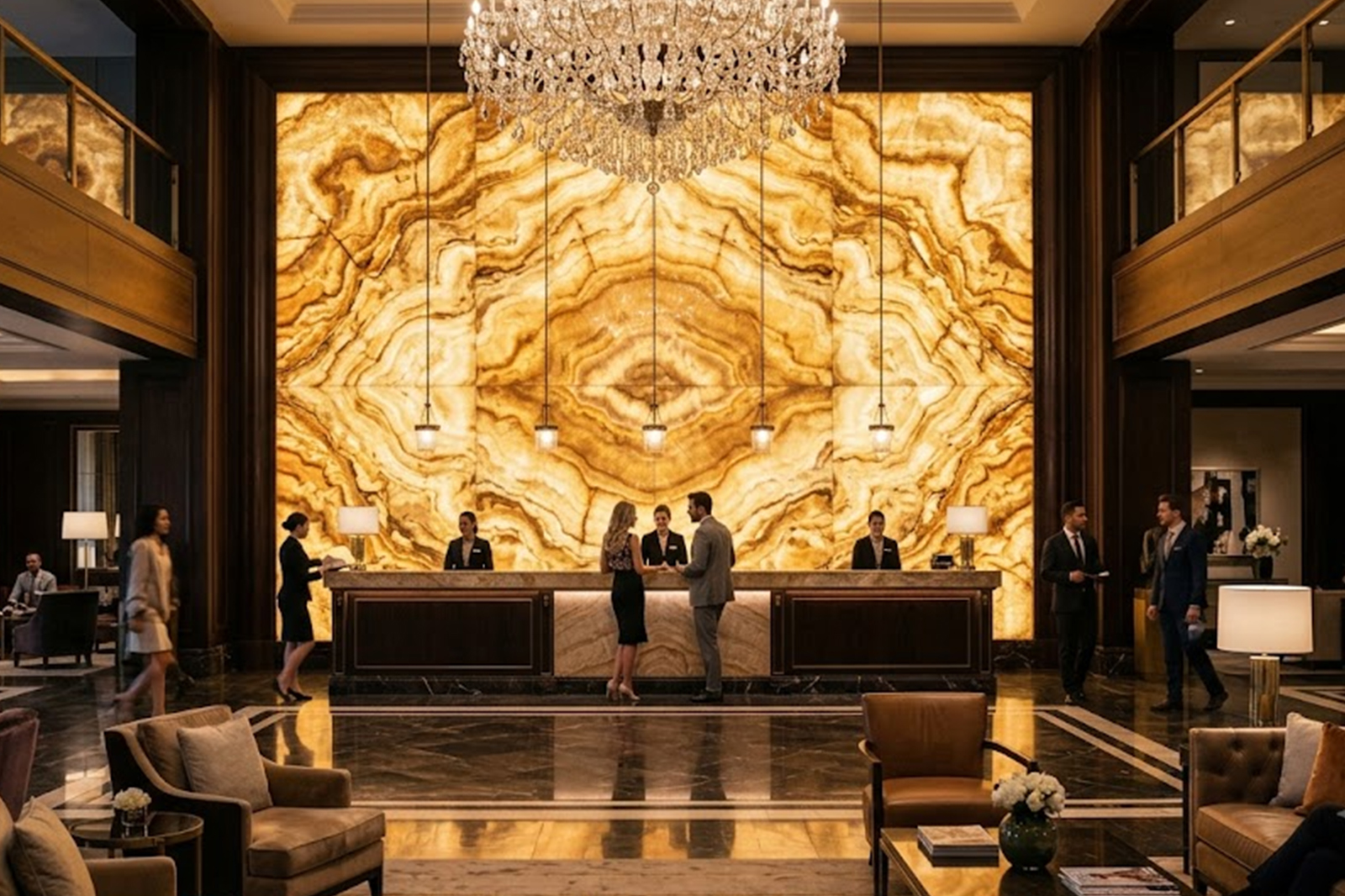
A luxury hotel chain in Dubai specified honey-gold onyx for the reception wall of a new 340-room property — 220 square meters of backlit panels requiring uniform translucency, consistent veining direction, and book-matched slab pairs across 12 vertical sections. Three onyx marble manufacturer candidates were evaluated. The first submitted sample images showing acceptable color but could not guarantee translucency consistency across the full order volume — their quarry source varied between two extraction zones with different crystalline structures. The second manufacturer, operating from a single-source quarry in Iran, delivered 4K HD scans of 48 sequential slabs cut from three adjacent blocks of the same geological layer, with translucency measurements (lux transmission at 20mm thickness) varying less than 8% across the batch. The lobby was installed in 14 days with zero slab rejections.
An onyx marble manufacturer capable of supplying 220 square meters of translucency-graded, book-matched slabs does not simply cut stone — the processing chain from quarry to delivery involves decisions at every stage that determine whether the final installation meets the designer's specification or falls short by a margin visible under backlight.
From Quarry Block to Finished Slab
Onyx is not geologically marble — it is a banded variety of chalcedony, a cryptocrystalline form of silica deposited by cold-water springs in limestone caves. Its value in architectural stone comes from translucency — the property that allows light to pass through the stone thickness when backlit. No other natural stone offers the combination of color saturation, veining character, and light transmission that onyx provides — but these properties exist only when the raw block is extracted, cut, and finished with translucency preservation as the primary quality metric.
Block selection at the quarry is the single decision with the greatest downstream impact. An experienced onyx marble manufacturer evaluates raw blocks by wetting the cut surface and measuring light transmission with a lux meter — not by visual color assessment alone. Blocks with crystalline bands thicker than 15mm transmit light unevenly, producing hot spots and dark zones in the finished panel. Blocks with micro-fractures invisible to the naked eye but detectable under backlight produce rejection-level defects that only become apparent after cutting and polishing — by which point the processing cost has already been incurred.
Cutting Technology and Yield Optimization
Onyx is softer than granite (Mohs hardness 3-4 vs 6-7) but more brittle than marble because its cryptocrystalline structure lacks the interlocking calcite grain boundaries that give marble its toughness. Diamond wire saw cutting at 20-25 m/s wire speed with water-based cooling produces the highest yield because the continuous wire applies uniform cutting force without the impact loading that gang saw blades deliver. A gang saw cutting onyx at 80-90 strokes per minute generates impact stress at each blade strike, producing micro-cracking at the cut surface that propagates during polishing — visible as hazing under backlight that requires additional resin treatment to correct.
Resin Treatment and Backlight-Ready Finishing
Every onyx slab leaving a competent onyx marble manufacturer has been resin-treated — an epoxy or polyester resin is applied to the slab surface under vacuum, penetrating micro-voids and stabilizing the stone structure. The resin serves three functions: filling natural pits and fissures that would otherwise trap polishing compound and produce dull spots, bonding micro-fractures to prevent propagation during transport and installation, and increasing the slab's flexural strength by 40-60% compared to untreated onyx — critical for the 20mm-thick slabs typical of backlit wall panel applications where the stone is suspended from mechanical anchors with no full-surface backing support.
Frequently Asked Questions
How does an onyx marble manufacturer ensure consistent translucency across a large order?
Blocks are sourced from a single quarry extraction zone — the same geological layer within the same quarry face — to minimize crystalline structure variation. Each slab is backlit and measured with a lux meter after polishing; slabs with light transmission outside ±10% of the batch average are re-graded for non-backlit applications. 4K HD scanning under backlight documents the translucency pattern of every slab, allowing the manufacturer to pre-match slabs before shipment.
What is the difference between onyx and marble in processing?
Onyx is softer (Mohs 3-4 vs 3-5 for marble) but more brittle — it fractures along crystalline planes rather than grain boundaries. Onyx requires diamond wire saw cutting at controlled speed (20-25 m/s) to minimize micro-cracking, while marble can be gang-sawn. Onyx requires 100% resin treatment under vacuum for structural integrity; marble resin treatment is optional and primarily cosmetic. Onyx polishing uses finer abrasives (up to 3000 grit vs 1500 for marble) to maximize light transmission.
What thickness of onyx slab is suitable for backlit applications?
20mm is the standard thickness for backlit wall panels — thick enough for structural integrity when mechanically anchored, thin enough to transmit sufficient light. 30mm slabs transmit approximately 40% less light and require higher-intensity LED backlighting, increasing energy and heat management costs. 10mm slabs transmit more light but require full-surface backing support that eliminates the floating-panel aesthetic.
How are onyx slabs transported without cracking?
Each slab is separated by foam spacers (minimum 10mm thickness) in a vertical A-frame crate. The crate is lined with vibration-dampening material at all slab contact points. Slabs are loaded at a 15-20 degree angle from vertical to distribute weight across the slab plane rather than the bottom edge. Ocean freight containers are specified with air-ride suspension for the trucking leg to minimize road vibration transfer to the crate.
Can onyx be used for flooring?
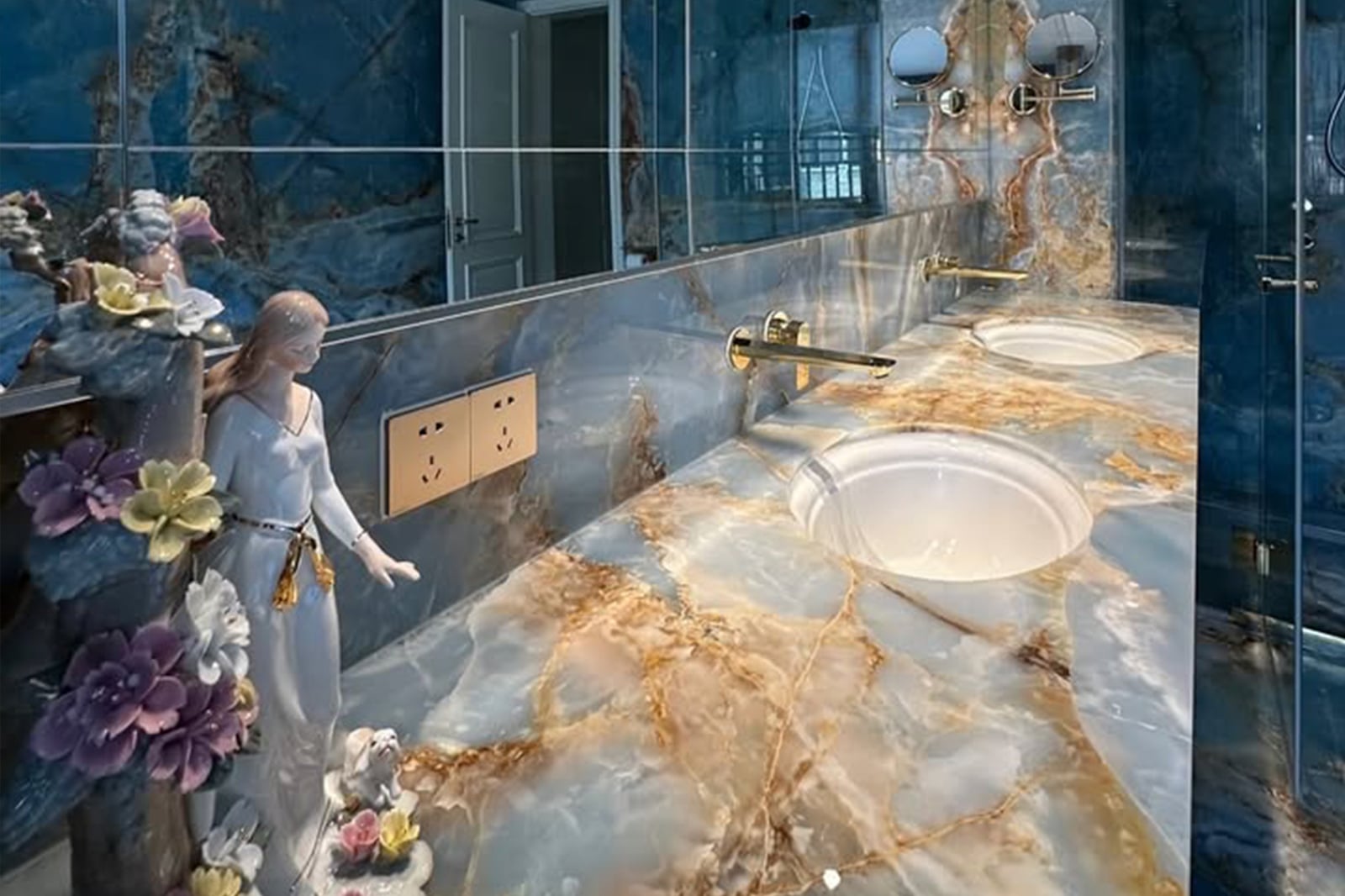
Not in high-traffic areas. Onyx at Mohs 3-4 scratches more readily than marble and is susceptible to acid etching from common spills. Low-traffic residential bathrooms and decorative wall accents are suitable applications. Flooring onyx should be specified at minimum 30mm thickness with a honed (not polished) finish to conceal wear, and the client should be informed of the maintenance requirement — annual professional re-honing to restore appearance.
How should backlit onyx panels be installed for even light distribution?
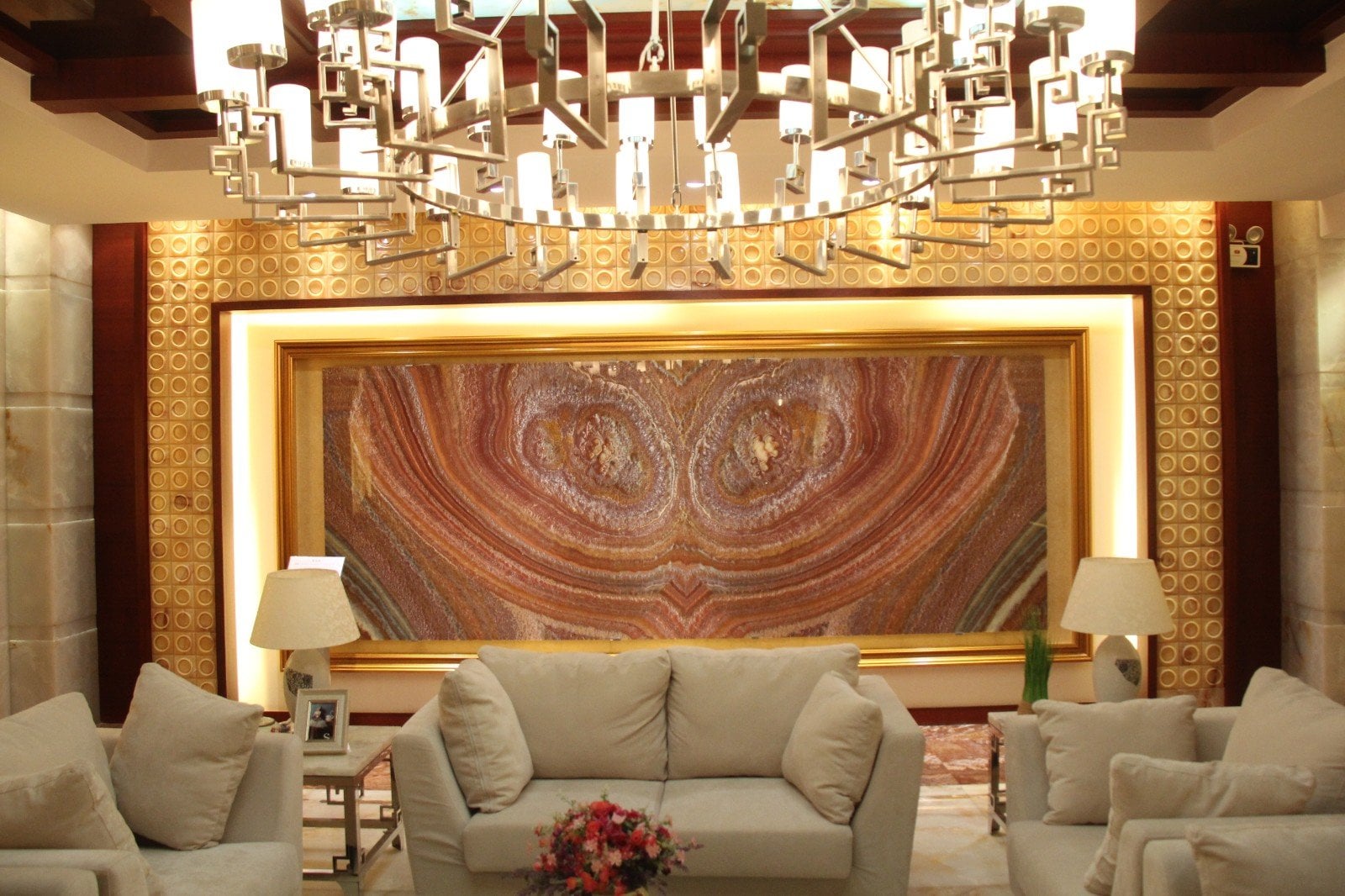
LED panels should be mounted with a minimum 100mm air gap behind the onyx. The gap prevents LED hot spots from projecting directly onto the stone surface — the light diffuses across the gap before reaching the stone. LED color temperature of 3000K-3500K complements warm-toned onyx (honey, gold, amber); 4000K-5000K complements cooler white and green onyx varieties. A diffuser panel (opal acrylic, 3mm) between the LEDs and the onyx further homogenizes the light field.