EN
EN

Backlit “Butterfly” Wall Panel in Patagonia Quartzite: A Full Project Fabrication Solution
2026/04/24
2026/09/02
When sourcing natural marble, buyers often find that the same marble name can come with surprisingly different prices. One supplier may offer a material at $50 per square meter, while another quotes $150 or even more. Does this mean one supplier is simply more expensive?
Not necessarily!
In the natural stone industry, the marble name is only the starting point. Since marble is a natural material, its value can vary significantly depending on its origin, rarity, quality, appearance, slab characteristics, processing requirements, and project specifications.
Here are 13 factors that can make the price of the "same" marble very different.
1. Origin: Where Does the Marble Come From?
The origin of marble is one of the first factors that influences its market value. Different quarries, even within the same country or region, can produce stone with different colors, textures, mineral compositions, veining patterns, block sizes, and levels of consistency. Marble from a well-known quarry with an established reputation may command a higher price because of its distinctive appearance and market demand. However, buyers should remember that country of origin alone does not determine quality. The specific quarry, block, and actual slab characteristics are much more important when evaluating the value of natural stone.
2. Quarry Rarity: How Difficult Is the Material to Obtain?
Some marble varieties are widely available, while others come from quarries with limited reserves or very low production of premium-quality blocks. When a quarry produces only a small amount of commercially desirable material, the price naturally increases. This is especially true for luxury marbles with rare colors, distinctive veining, or unusually large and stable blocks. In other words, the value of marble is influenced not only by how beautiful it looks, but also by how difficult it is to consistently obtain good-quality material from the quarry.
3. Marble Grade: Not Every Block Has the Same Quality
Even within the same quarry, not every block has the same quality. Some blocks may have a cleaner background, more attractive veining, fewer problematic fissures, better structural stability, or larger usable areas, while others may contain more natural variations or require greater treatment. Suppliers may therefore classify materials according to different quality levels. Two slabs carrying the same commercial name can have completely different visual and physical characteristics, which is why buyers should always confirm the actual grade and selection standard when comparing quotations.
4. Slab Size: Larger Slabs Can Carry a Premium
Slab size is another important factor, particularly for luxury residential and commercial projects. Large, high-quality blocks are not always easy to extract, transport, and process without damage, and they are therefore more valuable when they combine large dimensions with good quality and high usable area. Large slabs are especially desirable for kitchen islands, feature walls, hotel lobbies, luxury bathrooms, and other applications where fewer joints are preferred. However, larger does not automatically mean better—the real value lies in the combination of slab size, quality, appearance, and usability.
5. Background Color: The Base Tone Matters
The background color of marble can have a major impact on its value, especially for premium white, beige, and light-colored stones. Buyers may prefer a cleaner white background, a warmer or cooler tone, or a more uniform base depending on the design requirements of the project. Even under the same commercial name, different blocks can show noticeable variations in color and tone. For high-end projects where visual consistency is important, a particularly desirable background color can significantly increase the value of the selected slabs.
6. Veining: The Pattern Can Change the Value Dramatically
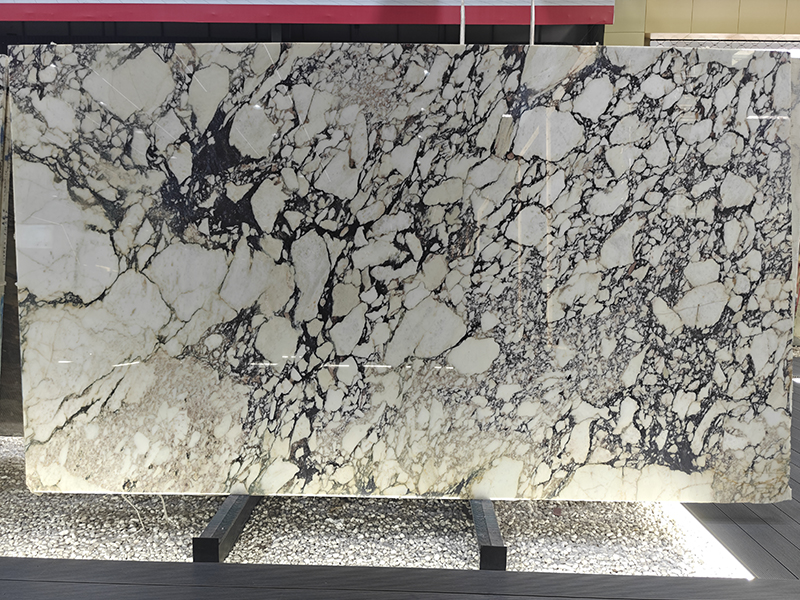
Veining is often one of the most important visual factors affecting the price of marble. Some buyers look for subtle, elegant veins, while others prefer dramatic movement, strong contrast, long continuous lines, or distinctive patterns. The value does not simply depend on how much veining a slab has, but on whether the pattern is considered desirable for the intended application. A dramatic slab may be extremely valuable for a feature wall or fireplace, while a more uniform material may be preferred for large flooring or commercial applications. In natural stone, the right pattern for the project often matters more than simply having more or less veining.
7. Fissures and Natural Characteristics
Natural marble can contain fissures, mineral lines, crystalline structures, and other geological characteristics formed during its formation. These characteristics are not automatically defects, but their location, size, openness, and influence on fabrication or structural stability need to be evaluated carefully. Two slabs of the same marble can therefore have very different values depending on their actual condition. Professional buyers should pay attention to whether fissures are naturally closed or open, whether they have been treated, and whether they affect the intended application rather than simply assuming that every natural line represents a quality problem.
8. Resin Treatment: Does Resin Mean Lower Quality?
Resin treatment is another factor that can influence how buyers perceive the value of marble. Some natural stones contain fissures, small voids, or areas that benefit from stabilization, and professional resin treatment can improve the slab's stability and processing performance. Therefore, the presence of resin does not automatically mean that the marble is low quality. What matters is why the treatment was required, how extensive it is, how well it was carried out, and whether the finished slab remains suitable for the intended application. A premium natural stone can still require professional treatment before it becomes project-ready.
9. Surface Finish: Processing Also Adds Value
The same marble can have different prices depending on its surface finish. Polished, honed, brushed, leathered, sandblasted, and other customized finishes require different processing methods, equipment, labor, and quality control. Some finishes are relatively standard, while others require additional processing or specialized techniques to achieve a consistent appearance. Therefore, when comparing quotations, buyers should make sure they are comparing the same surface finish rather than assuming that the material price alone determines the final cost.
10. Thickness: 2 cm and 3 cm Are Different Specifications
Thickness directly affects the amount of raw material required as well as processing, handling, and transportation costs. A 2 cm slab and a 3 cm slab may carry the same marble name, but they are not the same product specification. The appropriate thickness depends on the application, fabrication method, installation requirements, structural considerations, and local project standards. When comparing prices, buyers should always confirm that the quoted thickness is identical, otherwise a seemingly cheaper quotation may simply be based on a thinner or different specification.
11. Selective Slabs: Are You Buying Standard Material or Carefully Selected Material?
There is a major difference between purchasing standard commercial slabs and requesting carefully selected slabs for a premium project. Standard material may include slabs that meet the supplier's normal commercial quality range, while selective purchasing may require the supplier to inspect and choose slabs according to specific requirements for background color, vein direction, slab size, fissures, and overall visual consistency. The stricter the selection criteria, the fewer slabs will qualify, which naturally increases the procurement cost. This is one reason why a project requiring premium-selected slabs may receive a much higher quotation than a standard material order.
12. Same-Batch Material: Consistency Has a Cost
For large villas, hotels, commercial spaces, and other projects, buyers may require multiple slabs to have similar background colors, tones, and veining. This is much more difficult than simply purchasing the required quantity from whatever stock is currently available. Suppliers may need to reserve material from the same block or closely related production batches and carefully control the selection to minimize visual differences across the project. Natural stone can never be completely identical from slab to slab, but better batch consistency can create a more harmonious final installation—and achieving that consistency often comes with an additional cost.
13. Bookmatch: When Veining Becomes Part of the Design
Bookmatching can significantly increase the value and processing requirements of marble because the slabs must be selected and arranged so that their veins create a mirrored or continuous visual effect. This is commonly used for feature walls, luxury bathrooms, fireplaces, hotel lobbies, and other high-end applications. A bookmatched project requires more than simply finding attractive slabs; the supplier must consider slab sequence, vein direction, color consistency, dimensions, cutting layout, and material loss. The more complex the desired pattern, the more carefully the slabs need to be selected and managed, which is why bookmatched marble normally costs more than standard slab material.
So, Why Can the "Same Marble" Have Such Different Prices?
The key point is simple:
The same marble name does not necessarily mean the same product.
A standard commercial slab with an average background, mixed veining, different batches, and a standard polished finish is very different from a premium-selected slab with a clean background, desirable veins, large dimensions, carefully controlled natural characteristics, consistent batch selection, and a bookmatched layout.
This is why comparing marble based only on price per square meter can be misleading.
Before comparing quotations, buyers should make sure they are comparing the same material origin, quality level, slab size, thickness, surface finish, selection requirements, batch consistency, and processing specifications.
The Real Cost of Marble Is More Than the Stone Itself
A professional marble quotation reflects more than the value of the raw material. It also reflects the level of selection, processing, quality control, consistency, and project requirements involved in preparing the stone.
So when two suppliers give you very different prices for what appears to be the same marble, the better question is not:
"Why is your price higher?"
Instead, ask:
"What exactly is included in this price, and what specification am I receiving?"
In natural stone, you are not simply buying a marble name. You are buying a specific material, a specific selection, and a specific level of project suitability.

2025/07/09
This is a title description that can briefly introduce the module.